

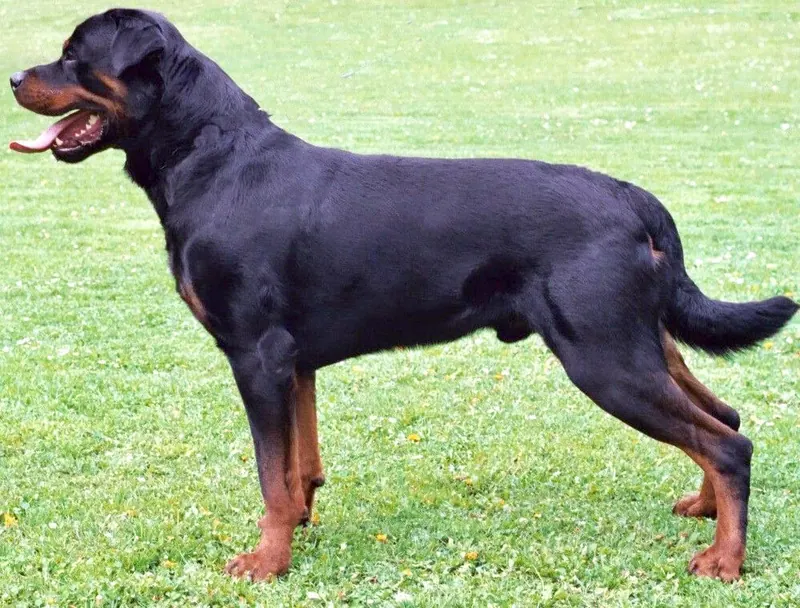
Side by side
Both columns come from the same cost model, so every row is a like for like comparison.
| Measure | Cavalier King Charles Spaniel | Rottweiler |
|---|---|---|
| Lifetime cost | $35,349 | $39,348 |
| First year | $6,605 | $7,125 |
| Monthly average | $250 | $309 |
| Puppy price | $1,800 to $3,500 | $1,500 to $3,500 |
| Routine care, yearly | $2,581 | $3,251 |
| Expected health cost | $2,986 | $0 |
| Documented conditions | 16 | 18 |
| Median lifespan | 11.8 yrs | 10.6 yrs |
| Adult weight | 13 to 18 lb | 80 to 135 lb |
| Daily food | 1.3 cups | 5.4 cups |
| Grooming, yearly | $480 | $250 |
| Risk profile | High, mid life | High, mid life |
| Biggest single risk | Heart murmur and mitral valve disease | Digestive disease |
Health risks compared
What tends to go wrong in each breed, how often, and what it costs to treat.
| Condition | Rate | Cost |
|---|---|---|
| Heart murmur and mitral valve disease | 31% | $534–$1,438 |
| Skin disease | 36% | $252–$679 |
| Degenerative myelopathy | 23% | not priced |
| Hip dysplasia | 16% | $1,200–$3,500 |
| Musculoskeletal disease | 15% | $281–$756 |
| Digestive disease | 11% | $354–$954 |
| Ear infection | 10% | $100–$270 |
| Heart (cardiac) murmur | 10% | $534–$1,438 |
| Dental disease | 10% | $246–$663 |
| Mitral valve disease (MVD) | 7% | $534–$1,438 |
| Anal sac impaction | 7% | $84–$226 |
| Umbilical hernia | 6% | $621–$1,671 |
| Keratoconjunctivitis sicca (KCS Dry Eye) | 4% | $224–$604 |
| Patellar luxation/Slipping kneecap | 3% | $1,000–$5,000 |
| Anal gland/sac impaction/blockage | 3% | $84–$226 |
| Arthritis | 3% | $281–$756 |
| Patellar luxation | 2% | $1,000–$5,000 |
| Elbow dysplasia | 2% | $3,000–$5,000 |
| Congenital heart disease | 2% | $534–$1,438 |
| Syringomyelia | n/a | $1,485–$3,999 |
| Expected total | $2,986 | |
| Condition | Rate | Cost |
|---|---|---|
| Digestive disease | 30% | $354–$954 |
| Musculoskeletal disease | 12% | $281–$756 |
| Skin disease | 11% | $252–$679 |
| Periodontal disease | 9% | $246–$663 |
| Cancer | 8% | $3,415–$9,194 |
| Anal sac impaction | 7% | $84–$226 |
| Ear disease | 6% | $100–$270 |
| Cruciate disease | 5% | $2,468–$5,640 |
| Arthritis | 4% | $281–$756 |
| Lipoma | 4% | not priced |
| Skin (cutaneous) cyst | 3% | not priced |
| Elbow dysplasia | 3% | $3,000–$5,000 |
| Hip dysplasia | 3% | $3,500–$7,000 |
| Autoimmune thyroiditis | 2% | $169–$455 |
| Otitis externa | 2% | $100–$270 |
| Bone cancer/tumour | 2% | $3,415–$9,194 |
| Patellar luxation | 1% | $1,000–$5,000 |
| Congenital heart disease | 0% | $534–$1,438 |
| Degenerative myelopathy | 0% | not priced |
| Bloat | n/a | $3,709–$9,986 |
| Expected total | $0 | |
Advertisement
Both breeds carry surgical risk, and premiums are priced by breed
Expected vet costs are $2,986 for the Cavalier King Charles Spaniel and $0 for the Rottweiler. Every policy excludes anything already diagnosed, so this is worth sorting out before you pick either dog.
Placement reserved — insurance-primary
Common questions
Is a Cavalier King Charles Spaniel or a Rottweiler more expensive?
The Cavalier King Charles Spaniel is cheaper by about $4,000 over a lifetime. Cavalier King Charles Spaniel: $35,349. Rottweiler: $39,348. The gap comes mostly from health costs rather than routine care.
Which lives longer, a Cavalier King Charles Spaniel or a Rottweiler?
The Cavalier King Charles Spaniel has the longer typical lifespan. Cavalier King Charles Spaniel: 11.8 years. Rottweiler: 10.6 years.
Which is healthier, a Cavalier King Charles Spaniel or a Rottweiler?
Both figures below are what it costs to own the dog, not what it costs if something goes wrong. The Cavalier King Charles Spaniel's biggest single risk is heart murmur and mitral valve disease, seen in 31% of the breed. For the Rottweiler it is digestive disease, at 30%.
How we calculated this
Both breeds run through one model, so the comparison is like for like. Full method.